By Nathaniel Gee, author of Failure and Fortitude: How Faith, Politics, and Power Shaped the Teton Dam Disaster
If you ever write a book, one of the first questions you will inevitably get is: Why?
It is an excellent question. It is one you will ask yourself hundreds of times.
You will ask it when you give up vacation days to sit in a library researching your topic. You will ask it when you stay up late or wake before dawn to steal a few more hours to write or revise the tenth draft. You will even lie to yourself and say it is for fame or money, although deep down you know those are not coming. The unsettling truth is that most of the time you do not really know why. You only know that you feel compelled to do it.
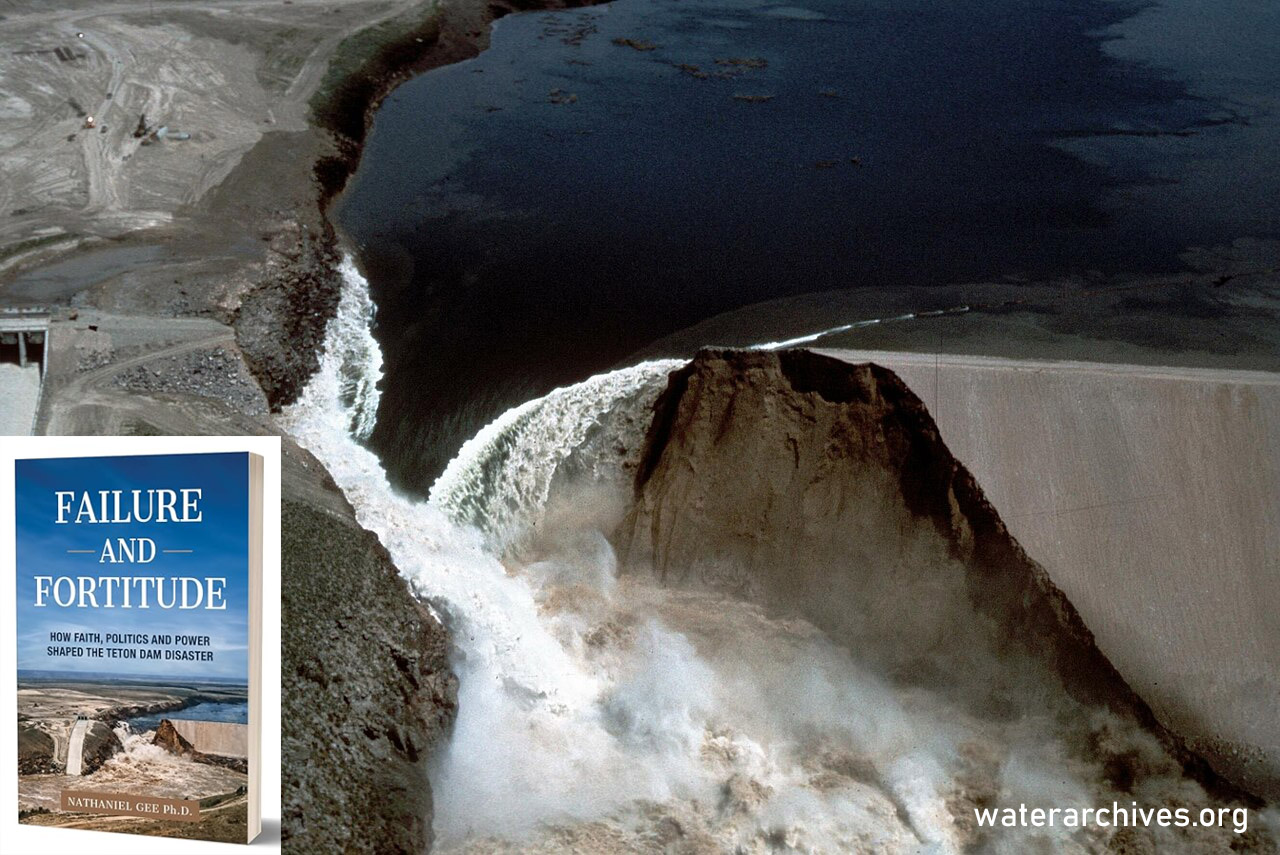
Teton Dam is the story that has haunted me for more than a decade. In 2016, as the fortieth anniversary approached, I attended a dam safety conference in Jackson Hole. I had been working at the Bureau of Reclamation for a few years, and Teton was always present in the mind of anyone in dam safety. It was the reason the Bureau’s dam safety program existed in the first place. It served as a constant reminder of why the work mattered and as the blemish on the record, we hoped never to repeat.
I wanted to contribute to the conference, so I began researching the subject that had gripped me most: the eleven people who lost their lives in the flood. I found gravesites, read firsthand accounts, dug through claims, and was stunned by what I discovered. I had heard vague stories of someone who died while camping or fishing downstream. That story was true. David Benson had been fishing in the canyon with his friend Daryl Grigg. Daryl survived with a collapsed lung and broken ribs, but David Benson became the first fatality of the Teton Dam disaster.
That was not what shocked me. Only six of the eleven deaths were from drowning. Three additional deaths were caused by heart attacks or overexertion during the evacuation. That still left two deaths unaccounted for. Eventually I learned that both were from gunshot wounds. One man died the day after the flood when a gun discharged in his truck as he went to protect his construction site from looters. The other was a self-inflicted death four days after the flood. She was a mother who had long struggled with depression. None of this was what I expected. Each of them had a story, and most had never been told.
That search led me to my own untold story of Teton Dam. I knew my aunt had lived in Rexburg at the time, and I vaguely remembered hearing stories as a child while cousins chased me around the backyard. So, I asked my dad.
“Yeah,” he said, “if the dam had failed twelve hours earlier, you would not be alive.”
I sat up. My dad had spent the night of June 4 with his brother in my aunt’s basement, a basement that would soon be filled with water. If the dam had failed at night with little warning, he could easily have been among the dead. Suddenly the story was not just professional. It was personal.
Later that year, I was reading one of the most influential books on western water, Cadillac Desert by Marc Reisner, when I came across his claim that the Bureau of Reclamation was “based on Mormon experience, guided by Mormon laws, run largely by Mormons.” Now my very religion was tied to the story. It did not take long to realize Reisner was wrong. In 1902, you would have been hard-pressed to find a group less interested in federal involvement in their lives than the Latter-day Saints of Utah and southern Idaho.
Piece by piece, I realized that nearly every part of my life, including family, faith, and profession, intersected at Teton. More importantly, the stories were far richer and more complex than anyone had told. Every puzzle piece I picked up revealed another untold story. That was when I knew I had to write this book.
I set a goal. I would tell the full story of Teton Dam. I would not limit myself to how it failed or to the extraordinary recovery. I wanted to tell the whole story. I thought it would be easy to finish by the fiftieth anniversary.
It took every minute to make that deadline, but the book reached the shelves in time. Now I cannot wait for you to encounter this story, one that has never been fully told, as you read Failure and Fortitude: How Faith, Politics, and Power Shaped the Teton Dam Disaster.
Praise for Failure and Fortitude: How Faith, Politics, and Power Shaped the Teton Dam Disaster
A fascinating retelling of one of America’s forgotten engineering failures! Nathaniel Gee weaves history, engineering, politics, religion, and humanity together in a seamless and compelling read. Essential reading for engineers, lawmakers, and history buffs alike.
Greg Richards, Chairman of Dam Failure and Incidents Committee for ASDSO
You can’t understand the American West without understanding water politics or the LDS Church. Both topics collide in Failure and Fortitude, Nathaniel Gee’s gripping and deeply researched account of the 1976 Teton Dam Failure. With a wide historical lens and a keen eye for characters, Gee tells the story not of a narrow technical failure but of a grinding social tragedy. This book is at once a vivid account of a very specific context—a remote, tightknit cluster of communities in an Idaho river valley—and a paradigmatic disaster narrative whose themes resonate across time and geography.
Tom Wooten, author of No One had A Tongue to Speak: The Untold Story of One of History’s Deadliest Floods
Gee’s storytelling, with first-person accounts of events, enables readers to visualize how intertwined dams were with many of the major events and milestones in the U.S. occurring from the mid-1800s to the mid-1900s. Building stories around the infamous Teton Dam failure, this is a must-read for those who are interested in the history of federal decision-making regarding water in the west, dam engineering and how human hubris can oftentimes overtake and negatively affect good intentions.
Lori Sprgens, Executive Director of Association of State Dam Safety Officials
Gee has constructed a remarkable story of the Teton Dam failure and its background by weaving together accounts of water and religious politics from Lincoln to Carter; of dam failures, 20th century dam building, and federal dam building juggernauts; of Church of Latter-day Saints western diaspora, governance, polygamy, and gradual integration into U.S. politics; of fascinating individual experiences during and after the disaster, and of disaster recovery histories and approaches. Gee used his background and access as a dam safety engineer in two of the foremost federal dam building agencies and as a Latter-day Saint to collect the stories and to pull together this in-depth and captivating account of events that led to and included the disaster and the recovery. His narrative reflects his background and covers fascinating examples of human behavior on both social and personal scales, from our tribal / institutional capabilities and shortcomings to human conflict, hubris, frailties, bravery, generosity, and resilience.
Lee Wooten, Vice President GEI Consultants
A Gripping Blend of History, Engineering, and Human Drama – Essential Reading on American Water Wars
My professional career has been involved with providing meteorological data to engineers and hydrologist to support the safe development and operation of critical infrastructure, including dams. Therefore, I am very familiar with dam disaster history and the intricate balance between safety and risk and how the need for dams and water in the western US is so critical. This book, Failure and Fortitude by Nathaniel is an excellent story about the infamous Teton Dam failure in 1976 and the intriguing history in the region and how the dam changes the dam safety industry going forward.
Nathaniel Gee, a dam safety professional with personal stakes in the story, provides extensive details related to the 1976 Teton Dam collapse and explains how this was not as an isolated tragedy but as the explosive result of decades of faith-driven settlement, political horse-trading, and the intoxicating pursuit of “taming” the West’s rivers. The opening chapters on the day of the failure read like a thriller—tense, minute-by-minute drama with real heroes and heartbreaking losses. The book gets into detail starting with the Mormon Church pioneers, the birth of federal reclamation projects, and iconic fights like Hoover Dam, all while exposing how cost-cutting and hubris led to catastrophe.
The book is presented in a way that both engineers involved in dam design and construction will find this very interesting while at the same time general readers with limited knowledge of dam design will be able to follow the story and tragedy as told through poignant oral histories bringing the human cost to life. The role of religion and politics feels fresh and nuanced, showing how good intentions can pave the road to disaster. At 259 pages, it’s thorough without dragging, and the lessons on modern dam safety are timely in the context of current debates about dams and dam safety.
If you liked Cadillac Desert or disaster docs like The Johnstown Flood, this is a must-read. Released just in time for the 50th anniversary, it’s a sobering reminder of nature’s power and humanity’s flaws. 5/5 stars—highly recommend!
Bill Kappell, CEO of Applied Weather Associates